Shui On Land: Buyer confidence is key in China's latest housing reforms
China authorities have unveiled new homebuying policies to strengthen the real estate financing systems for both developers and households. In response, Shui On Land is focusing on completion and delivery of high quality projects rather than growth at all costs.

In a surprise coordinated announcement, China authorities have unveiled new homebuying policies to strengthen the real estate financing systems for both developers and households. Under the updated credit guidelines, mortgages for presale homes will only be issued after the project's completion has been officially registered, while completed new homes will have mortgages issued post-purchase registration. To support demand, the maximum term of these personal housing loans has been extended from 30 years to 40 years.
Fundamentally, it is clear that these policies are aimed at buyer protection, curbing speculation and minimizing project delivery risks to homebuyers.
The first knee-jerk reaction was the concern over how existing property developers can transition to this new cash flow reality. For many of these companies, the new rules meant that deposits from homebuyers can no longer be used to fund the development cost of the residential projects. Presale proceeds have long been a common funding source for the property development industry, and a shift in this business model towards what is essentially a completed-home sale will require substantial adjustment to working capital management.
Many small and medium scale developers rely extensively on the presale model to landbank and grow the business. As a result, the new regulations will likely trigger an industry-wide consolidation where only the largest developers with strong balance sheet can remain competitive. Smaller developers may see around 40% reduction in their capital available for reinvestment, dampening sentiment for land auctions and ultimately attracting takeovers from larger peers.

Shui On Land has been a casualty of this real estate downcycle, with investors throwing the company out with the bathwater. With their flagship urban renewal projects under the Xintiandi banner, the company is a pioneer in transforming and refreshing prime locations in cities into integrated developments comprising residential, offices and retail stores. Even though their revenue is now reduced to a fraction of their peak years, the company's prudence and capital discipline steered the business clear of financial woes faced by many of its larger peers.
While this latest regulatory move may be construed by industry watchers to be further crippling real estate companies at a time when the industry had already been in a multi-year downturn, it is nonetheless a healthy structural reform for the long-term. Authorities are willing to support good-standing developers in obtaining alternative funding channels such as bank financing and fundraising from capital markets, thereby shifting the risks from homebuyers to professional creditors and investors.
Commercial bank development loans can now be extended up to a maximum of 5 years for presale projects and up to 7 years for completed-home sales projects. In addition, the ‘whitelist’ system has already been implemented prior to this reform, encouraging banks to lend to developers of high conduct. The intention of the authorities is to move towards project-basis accountability rather than company-level credibility. Qualified projects with closed-loop accounting are highly-favoured as these are projects where cash flows are contained within the project and cash flow visibility is high and straightforward.
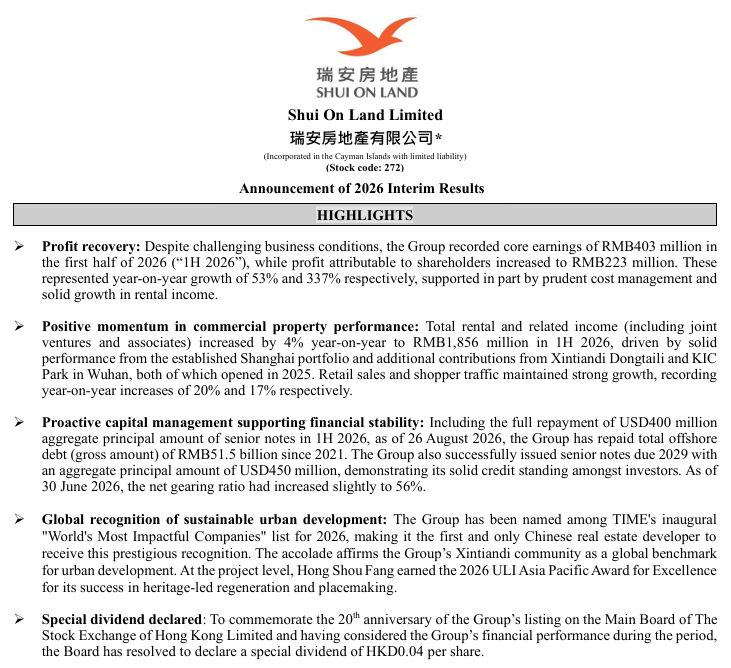
Towards this end, Shui On Land has actually successfully refinanced its maturing debt with new US$450 million 2029 senior notes earlier this year (albeit at high coupon rate of almost 10%). It was a strong show of investor support in a sector mired by bankruptcies. Furthermore, Shui On Land took the opportunity to also declare a special dividend for shareholders to commemorate the business's 20th year anniversary listing in Hong Kong, further reflecting the resiliency of its balance sheet.
With the company's market valuation at more than 90% discount to its net asset value, Shui On Land has been proactively looking to divest non-core assets and close the valuation gap. Just this month, an agreement was inked to sell its Chongqing property, aligning the transaction to the overall strategy of improving cash flow and realising the value of these commercial properties at book value.
As the industry grapple with this new regulation, short term adjustments will likely impact supply of new homes as developers are more cautious in their land biddings. However, this may not be that much of an issue since Tier 2 and lower cities are currently facing oversupply conditions. The increased confidence of homebuyers may be a larger net benefit to the sector if volume picks up as a result of this change.
With the successive rounds of reform policies over the past four years, these measures have culminated in a structural reset and reined in developers’ ambitions and aggressive behaviour of the past cycle. Going forward, a more prudent development of China housing sector, underpinned by enhanced risk controls and a refrain from growth at all costs mentality, will hopefully arrest the current decline and lead real estate back to its former glory of an important economic growth driver in a renewed regulatory framework.
For Shui On Land, the company is treading cautiously, focusing on completion and delivery of high quality projects rather than growth at all costs. It is one of the few developers who has the ability to landbank selectively and opportunistically, while its high-end residential projects continue to achieve good take-up rates by appealing to a stable base of high net worth buyers. Adjusting to this reality of smaller development profits eclipsed by property management and rental income may be a painful transition, however it is one which will help smooth out the industry cycles and contribute to the long term sustainability of the business.