Coupang: International market expansion is no mean feat
While there have been negative headlines surrounding Coupang, the company remains steadfast in their international expansion and building out their fulfilment and logistics infrastructure.
Coupang’s journey as a public company involved the twists and turns of several high-profile events. The latest stemmed from the financial penalty imposed by Korean authorities on the data breach of its customers.
Even though Coupang has tried to salvage the situation with compensation vouchers to over 33 million users, the scale of compromised personal data escalated into a diplomatic tension between the US and South Korea since the company is headquartered and listed in the US while their business operations are almost entirely in South Korea. This incident has been a major overhang for Coupang, both financially and optically for the company’s reputation.
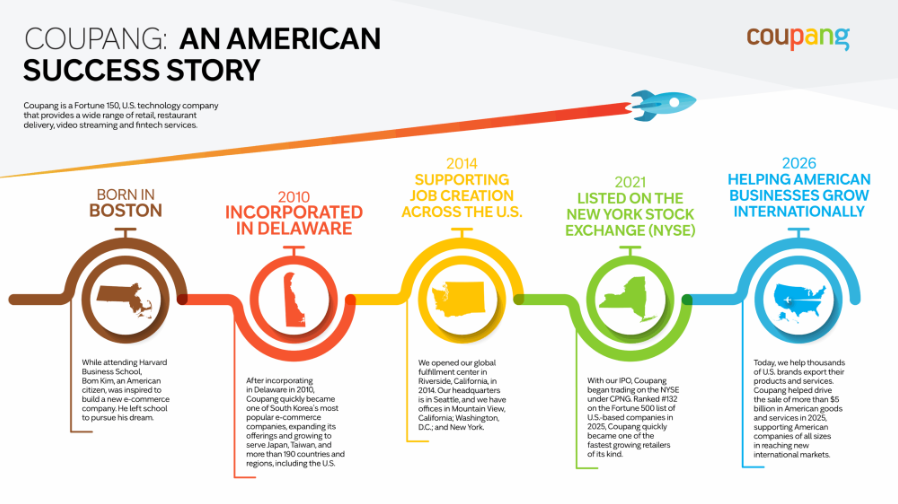
Beyond the data leakage, the founder of Coupang is also dealing with a reclassification of the business from a governance perspective. The Korea Fair Trade Commission designated Coupang as a chaebol-like entity, increasing regulatory disclosures and oversight of the company. This will likely further pressure executive decisions, potentially driving another wedge into the status separation of Coupang Inc’s US incorporation and Coupang Corp’s Korean operating subsidiaries and affiliates.
At the same time, the Korea Fair Trade Commission also rejected a settlement between Coupang and local competitor Baemin a few weeks ago, on grounds of unfair business practices related to anti-competition in the food delivery market. This will likely expose the two companies to financial penalties, including remedies such as reduced fees to compensate consumers and merchants if the final investigations found them in violation.
While these negative headlines and publicity affected investor confidence of Coupang, there is no denying that the company remains steadfast in their strategic priorities of international expansion and building out their fulfilment and logistics infrastructure.
The pivot from a traditional first-party logistics business into an asset-light third-party logistics partner is a commitment towards expanding long-term profitability. The maturity of Coupang’s proprietary warehousing and delivery network system within South Korea has created a competitive advantage towards cementing its market leadership in the e-commerce market there.
At this point, the playbook looks very similar to what Sea’s Shopee has been trying to achieve regionally. With its marketplace origin, Shopee has been operating on this model for many years, with recent investments also focusing on the logistics side of the business. This is to achieve highly scaled economics on offerings such as next-day delivery and optimization of managed services for merchants. The superiority and durability of last mile profit margins will add to the defensiveness of the company against potential new entrants.
Rightfully so, Coupang has allocated considerable resources towards this infrastructure build-out. By managing an integrated warehousing and delivery value chain with nationwide coverage, the company hopes to further drive efficiency gains of its distribution and fulfilment centers through automation. None of these business strategies are novel, but they have proven to be effective in the examples of Amazon in US and JD.com in China.
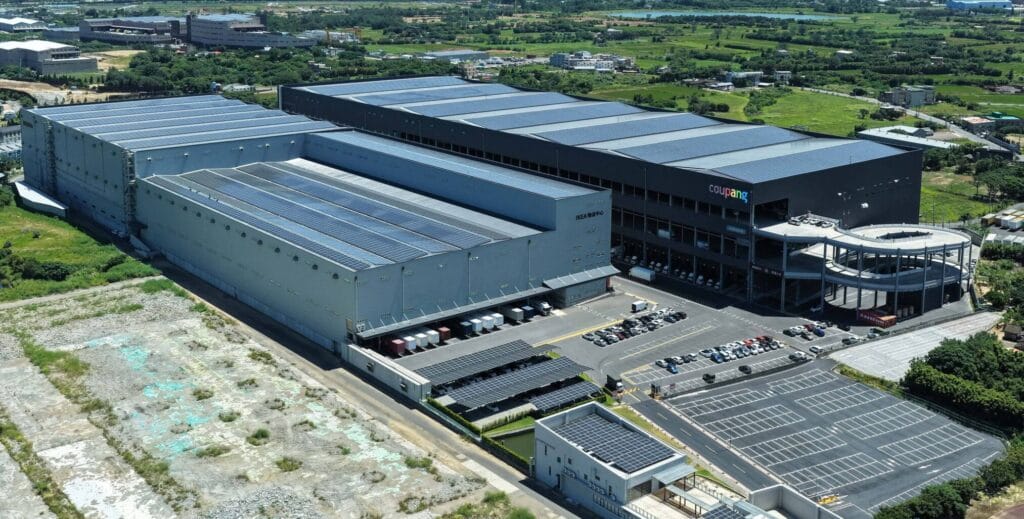
Outside of South Korea, Coupang’s expansion can be observed to be more challenging. Taiwan has been identified as the next market to break into, but incumbents like Shopee have already been deeply entrenched in consumer’s purchasing behavior. While not impossible, it will require high sustained levels of cash burn to acquire these users. Many bigger platform companies, such as food and groceries delivery players internationally, have already retreated from Asian markets in recent years.
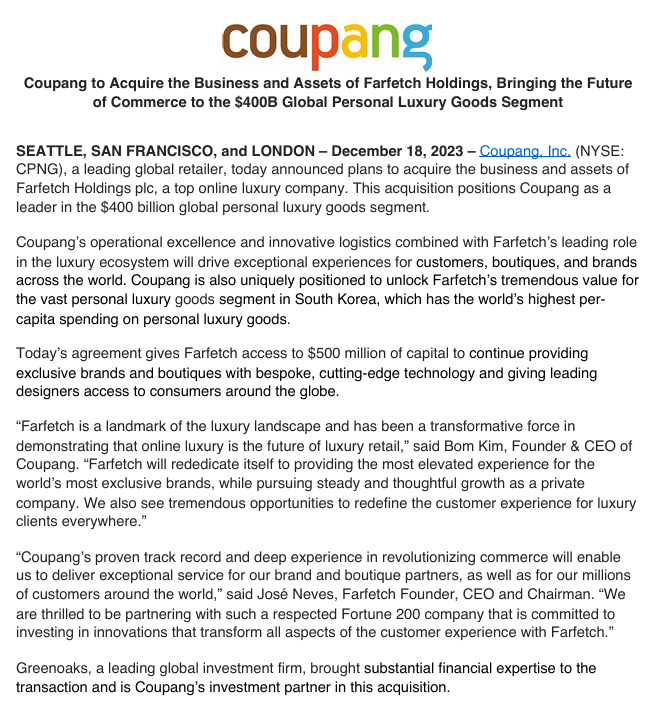
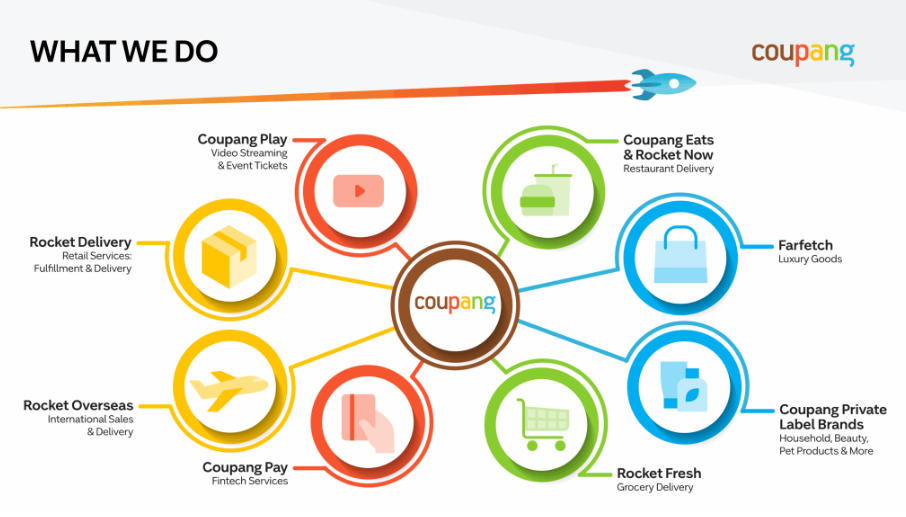
A final piece of the puzzle for Coupang’s business expansion is into the premium luxury segment. The company took advantage of the market opportunity to acquire distressed Farfetch in early 2024. Rather distinct from Coupang’s other growth areas like Coupang Eats, Coupang Play and Rocket Now, Farfetch is strongly positioned in the luxury marketplace segment, with a more diverse and international customer base than other offerings which we will expect to be in a Coupang’s ‘Superapp’. From the commerce lens, Farfetch provides a more global and premium access to customers, highly complementary to the core commerce business of Coupang. Therefore, a successful integration and restructuring of Farfetch has the potential to move the needle for Coupang compared to adjacent ecosystem plays within Coupang’s ‘Developing Offerings’ revenue segment.
At Coupang’s current phase, it is a crucial balancing act between defending its home turf from possible competitors backed by deep-pocketed domestic giants like Naver, and scaling their international business fast enough to offset the slowing growth in South Korea. Rising regulatory risks is another reason pushing the company to look regionally to diversify its presence. Underpinned by the ambitions of a regional ‘superapp’ digital ecosystem, the stakes are high for Coupang to stick to a disciplined capital allocation strategy and execute on its immediate priorities.